Wednesday, November 26, 2014

Red Sox introduce Ramirez, Sandoval


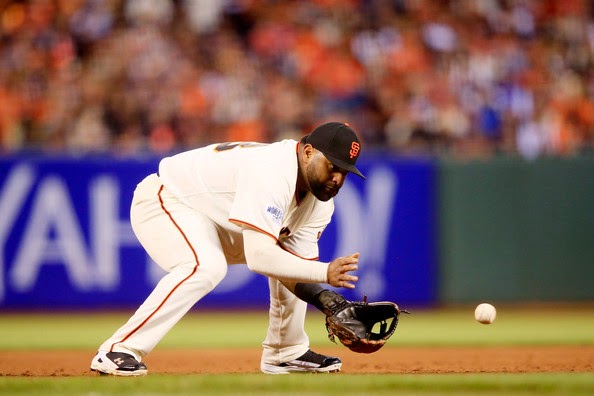
(Source : Harry How/Getty Images - Rob Carr/Getty Images)
(Source: Boston Globe)


(Source: NESN)

Tuesday, November 25, 2014

Red Sox agree to deal with Pablo Sandoval

(October 23, 2014 - Source: Jamie Squire/Getty Images North America)


Multiple sources are reporting that the Boston Red Sox have agreed to a five-year, approximately $100 million dollar contract with free-agent third basemen Pablo Sandoval.

The news leaked shortly after Boston made it's first big acquisition of the hot stove season, inking their former top prospect Hanley Ramirez to a 5-year/$90 million deal.

Despite having a larger offer on the table from the San Diego Padres, many speculated that the Sandoval would leave San Francisco to join the Boston Red Sox.

Sandoval had dinner last week with David Ortiz, before meeting with the Red Sox ownership the following day. According to Sandoval's brother and co-agent, the three-time World Series champion was shown "first-class attentiveness" by the organization.

The "Kung Fu Panda" is a career .294/.346/.465 hitter in seven seasons with the San Francisco Giants, where he collected 106 home runs and 462 RBIs. Even more impressive are his career numbers in the post season, where he owns an eye-opening .344/.389/.545 batting line, including .426/.460/.791 in the Fall Classic.

After starting off the 2012 World Series with three home runs in Game 1, Sandoval would go on to win his first World Series MVP award:


After spending $192 million combined on Sandoval and Hanley Ramirez, the Red Sox are still going to be faced with some questions before heading to Ft. Myers in February to begin Spring Training.

Many suspect that Sandoval will take over at third base, where Will Middlebrooks has yet to live up to his potential since taking over the job in 2012. Although Boston allegedly had some small concerns with Sandoval's weight, they reportedly offered contract incentives for him to keep off whatever pounds he may lose over the course of the deal. It may stand that they look to move Sandoval into a DH role after a couple seasons, or perhaps even first base if Mike Napoli leaves in free agency next winter.

Hanley Ramirez has spent most of his career on the left side of the infield, mainly shortstop, but had expressed a willingness to change positions to increase his value during the off-season. The Red Sox have shown interest in playing him in left field, which would almost certainly be the end of Yoenis Cespedes' short stay in Boston. Cespedes was acquired at last years' trading deadline, but seems a lock to test out the free agency waters next winter over negotiating a contract extension.

However, with major holes in their pitching rotation it may be that the Sox look to keep Ramirez in the infield by trading young shortstop Xander Bogaerts in a deal for a starting pitcher. The Phillies have been quite outspoken in their bid to trade Cole Hamels in exchange for multiple top prospects, and with the surplus of young talent in Boston's minor leagues, they might be willing to package a deal around Bogaerts that would alleviate multiple issues.

Although they are still far from certain of what their lineup will look like come opening day, the Sox can now start to turn their focus to the depleted pitching staff after locking up two veteran bats.

Red Sox agree to deal with Hanley Ramirez

(October 6, 2014 - Source: Dilip Vishwanat/Getty Images North America)


Hanley Ramirez is coming home.

Per Ken Rosenthal, the Boston Red Sox have agreed in principle to a four-year, approximately $90 million contract with one of their former top prospects, Hanley Ramirez.

The signing is the first major acquisition of the off season for the Red Sox, who are also rumored to have heavy interest in third baseman Pablo Sandoval and starting pitcher Jon Lester.

The 30-year old Dominican native turned down the $15.3 million qualifying offer he received from the Dodgers earlier in the month, which will force Boston to surrender it's second round pick to Los Angeles. Because the Red Sox finished with a record in the bottom 10 teams last season, their first round pick (7th overall) will be protected.

Many are speculating that the Red Sox are looking to move Ramirez to left field, which would almost certainly spell the end of Yoenis Cespedes’ time in Boston.

Back in late-October rumors began to spread that Cespedes is not well liked by Boston's coaching staff, and he has shown a willingness to test the free agent market after next season instead of negotiating a new contract. Boston acquired Cespedes at the trade deadline in exchange for Jon Lester and outfielder Jonny Gomes.

With the Boston rumored to be the front runners in the Sandoval sweepstakes, and also in desperate need of starting pitching, another option might be to keep Ramirez in the infield and look to deal young shortstop, Xander Bogaerts,to help bolster their rotation.

Hanley spent the 2014 season with the Los Angeles Dodgers where he hit .283/.369/.448. However, Ramirez was limited to only 128 games last year which was evident by his 13 home runs and 71 RBIs.

Ramirez's health issues in recent years have been no secret, but when healthy he owns a very respectable career line of .300/.373/.500.


Those numbers mesh much better with a Boston lineup built around getting on base over Cespedes' lackluster career line of .263/.316/.464.

 The only issue might be keeping Ramirez on the field, but with a surplus of outfielders the Red Sox could be in a great position to afford regular rest to some of their starters.

After beginning his career in the Boston organization, Ramirez was traded alongside Anibal Sanchez to the then Florida Marlins in exchange for Josh Beckett and Mike Lowell, who would be instrumental in bringing home a World Series title for the Red Sox in 2007.

After six and a half seasons with the Marlins, Ramirez was again traded in 2012 to the Los Angeles Dodgers with Randy Choate for Nathan Eovaldi and a minor league pitching prospect.

Tuesday, November 11, 2014

Ted Williams - A True American Hero

(Ted Williams)

It is rare among baseball circles to find anyone who doesn’t agree that Ted Williams was one of the greatest hitters to ever play the game.

Known by some as “The Kid” or “The Splendid Splinter”, the California native spent his entire career playing for the Boston Red Sox. In 19 seasons he amassed a career line of .344/.482/.634 to go along with 521 home runs and 1,839 RBIs (the final of which came in his last career at-bat at Fenway Park on September 28, 1960).


Williams also earned numerous awards during his time with the Red Sox:
  • 1939 American League Rookie of the Year
  • 19x All-Star (1940-42, 1946-51, 1953-1960)
  • 2x American League Most Valuable Player (1946, 1949)
  • 2x Triple Crown Winner (1942, 1947)
  • 6x American League Batting Champion ( 1941-42, 1947-48, 1957-58)
  • 4x American League Home Run Champion (1941-42, 1947, 1949)
  • 4x American League RBI Champion (1939, 1942, 1947, 1949)
  • Last MLB Player to Record a .400 Season (Hit .406 in 1941)
  • MLB Record .482 Career On-Base Percentage
  • First Ballot Hall of Fame Inductee (1966)
As impressive as Williams’ career statistics were, many are left to wonder how much more incredible his numbers would have been had he not given up three full seasons during the prime of his career (and the majority of two others in 1952-53) to serve as a fighter pilot in the United States Navy and Marines Corps.
Not long after Williams went on to own the last .400+ season in the majors in 1941, the US was attacked by Japan at Pearl Harbor on December 7, beginning the United States’ involvement in World War II. Williams’ was drafted into the military the following January as Class 1-A (available for unrestricted military service).

 At the time Williams was the sole dependent of his mother, and sought to change his classification to 3-A (deferred because of hardship to dependents). After initially being denied his request, Williams’ attorney was able to have the case handed over to the Presidential Board, where he was in fact reclassified as 3-A in the following days.

Ted took extreme backlash from the public regarding his reclassification, which even caused some major sponsors such as Quaker Oats to drop Williams from their advertising campaign.

However, after building up his mothers’ trust fund, Williams would indeed enlist in the Navy Reserve not long after in May of 1942, before going on active duty later that year. He was commissioned a second lieutenant in the United States Marine Corps as a Naval Aviator, nearly two years after joining the reserves.

Williams would not see any combat action in his first wartime stint, spending most of the time he wasn’t flight training playing for military baseball teams.

After the US dropped atomic bombs on Hiroshima and Nagasaki, Williams was re-stationed to Pearl Harbor where he would play in an eight team baseball league alongside Joe DiMaggio and Stan Musial. Some players were quoted as saying that the Service World Series between the Army and Navy was better than the World Series between the Detroit Tigers and Chicago Cubs back on home soil.

Although he would not fight in World War II, he performed exceedingly well in virtually every area of his flight training. He holds a student gunnery record that still stands today for reflexes, coordination and visual reaction time. He was so talented and enjoyed his time flying so much, he was literally forced by the Navy to leave in order to accept his 1942 Major League Triple Crown award in person.

 His fellow Red Sox teammate Johnny Pesky, who attended the same aviation training program, gave Williams overwhelming praise for his knowledge and skills as a fighter pilot:

"He mastered intricate problems in fifteen minutes which took the average cadet an hour, and half of the other cadets there were college graduates.

 “Ted could make a plane and its six 'pianos' (machine guns) play like a symphony orchestra - his reflexes, coordination, and visual reaction made him a built-in part of the machine."

In 1945, Williams would be discharged from the military and return to Boston to play for the Red Sox until he was called up from the inactive reserves in 1952 during the Korean War. After having not flown a single aircraft in eight years, Williams would head to Cherry Point, North Carolina to begin his refresher training on the newer jet aircraft being used in the war.

Williams arrived in Korea in early 1953 and would begin flying his first ever combat missions.

It would not take long for “The Kid” to find himself in danger. On February 17, 1953 he was forced to crash-land his F-9 Panther after taking small arms fire from the ground, while flying an air mission with the 33rd Marine Air Group in Kyomipo, 15 miles south of the North Korean capital.

Afraid that ejecting would cause him to break his knee caps and end his post-military baseball career, Williams instead refused to bail out of his aircraft and crash landed it at an United States Air Force airfield called K-13, tucked just behind enemy lines.


Given to pilots for meritorious achievement while participating in sustained aerial flight operations, Williams was given the Air Medal for his actions that day (one of the many medals he would receive during his military career).

(Ted Williams Military Awards & Honors)

Ted would experience another close call a few months later in April when heavy wind would force him to lower his altitude during a raid of Chinnampo, where he was hit by anti-aircraft fire. He considered himself lucky that the reserve fuel being stored in his wings did not ignite, which allowed him to make it back to base safely.

If the stresses of engaging in aerial combat were not enough, Williams often found himself sick in Korea. He developed pneumonia and eventually an inner-ear problem that would lead to him being withdrawn from flight status and leaving the Marines in July of 1953.

Ted returned home to Boston and resumed his baseball career (due large in part to the fact he refused to eject from his aircraft back in February) basically right where he left off, despite missing time in 1954 with a broken collarbone and another month in 1955 due to a nasty divorce settlement with his wife Doris. He would hit his 400th career home run the following season in 1956, and would lead the majors in batting average in both 1957 (.388) and 1958 (.328) at the elder baseball ages of 39 and 40.

He remained an ambassador to the game well into his later years, even going as far as calling for the recognition of Negro League players during his Hall of Fame induction speech in July of 1966.

"I've been a very lucky guy to have worn a baseball uniform, and I hope someday the names of Satchel Paige and Josh Gibson in some way can be added as a symbol of the great Negro players who are not here only because they weren't given a chance."

For new and old generations of fans alike, few will forget the scene at Fenway Park during the 1999 All-Star game, where Ted Williams would make one of his final public appearances before passing away in 2002:


During Williams’ four year military career, he was credited with 39 combat missions (all coming during the Korean War) including his two brushes with death. When asked about his time in Korea he was quoted as saying:

“I was no hero. There were maybe seventy-five pilots in our two squadrons and 99 percent of them did a better job than I did.”

In a day and age where baseball players are making more money than any time in history, where we are used to seeing our star athletes pampered and coddled as if they are made of glass, it’s hard to imagine anything more heroic than a superstar athlete, and face of the sport, giving up prime years of his career to serve his country.

There will forever be the debate about where Williams ranks among the other great hitters in history, or where his numbers could have been had he not served his country for multiple years.

Instead of worrying about rankings or statistics, let’s remind ourselves how lucky we are to live in a country where the selfless men and women of our armed forces put their lives on the line everyday so we can enjoy some peanuts and a hot dog, and perhaps even a cold beer, while watching America’s pastime.

To all those who have served – thank you and Happy Veteran’s Day.


References:
  • Linn, Ed. Hitter: The Life And Turmoils of Ted Williams. Harcourt Brace and Company, 1993.
  • Bullock, Steven R. Playing for Their Nation: Baseball and the American Military during World War II. University of Nebraska Press, 2004.
  • Mersky, Peter B. U.S. Marine Corps Aviation: 1912 to the Present. Annapolis, Maryland: Nautical and Aviation Publishing Company of America, 1983.
  • Montville, Leigh. Ted Williams: The Biography of an American Hero. New York: Doubleday, 2004.
  • "Official Ted Williams Website." Official Ted Williams Website. Green Diamond Sports, Inc, n.d. Web. 11 Nov. 2014.

Tuesday, October 28, 2014

Jake Peavy Looks To Bring San Francisco Third World Series Championship Since 2010

(October 21, 2014 - Source: Jamie Squire/Getty Images North America)

For the second consecutive season, 33-year old RHP Jake Peavy was traded in July from a worst place team to a team destined for the World Series. He will have a chance to bring home his second straight championship ring when he takes the mound for Game 6 against the Kansas City Royals tonight at Kauffman Stadium.

On July 30th of last season, Peavy was traded to the eventual world champion Boston Red Sox in a three-way trade involving the Chicago White Sox and Detroit Tigers. Boston would go on to defeat the Detroit Tigers in the American League Championship Series, giving Peavy his first opportunity at a World Series ring in his 12 year career.


Peavy made his World Series debut by starting the third game of that series, and although he only lasted four innings, he allowed just two earned runs and gave his team an opportunity to win the ballgame. What most people will remember about that game, however, is the famous obstruction call in the bottom of the ninth, the first of its kind to end a World Series game in MLB history:


Fast forward to July 26th of this season, Peavy was once again traded as part of Boston’s massive roster overhaul, to the San Francisco Giants for pitching prospects Edwin Escobar and Heath Hembree.

After a rough start to his season, partly due to Boston’s inability to give him any run support, Peavy rebounded nicely posting a 6-4 record with a 2.17 ERA and 1.04 WHIP in 12 starts for San Francisco.


On August 30, Peavy nearly threw the first no-hitter of his career against the Milwaukee Brewers. He would finish the night with 7 2/3 scoreless innings and eight strikeouts, including the 2,000th of his career.


The Mobile, Alabama native was drafted 472nd overall by the San Diego Padres in the 15th round of the 1999 Major League Baseball Draft. After going 44-1 during his high school career, including 13-0 his senior year, Peavy turned down an offer to play for the Auburn University Tigers to accept his first professional contract.

Peavy would work his way up through the minors before making his major league debut with the Padres in June of 2002. In his first professional season he would go on to make 17 starts for San Diego, owning a 6-7 record with a 4.52 ERA and 1.42 WHIP in 91.2 innings pitched.

Yet it wasn’t until 2004 that Peavy would start to make his name as one of the top pitchers in baseball. That season Jake put up a respectable 15-6 record, but even more impressive was his National League leading 2.27 ERA, all while striking out nearly ten batters per nine innings.

A few seasons later in 2007, the 6”1’ righty would have the greatest season of his career. Peavy would put up a 19-6 record to go along with a 2.54 ERA and 240 strikeouts; good for the National League’s pitching Triple Crown and Cy Young awards.

Although he has struggled to replicate that same success since his Triple Crown performance in 2007, it’s no secret that Peavy is regarded as one of the better teammates and clubhouse presences in the majors, which should be obvious after by back-to-back mid-season acquisitions by World Series contenders:

"He brought a lot of fire when he came here," said Giants’ manager Bruce Bochy. "We have a great culture here, but he added to it and brought a lot of intensity.

"The guys can see how he goes about his business and the respect he gets from the other pitchers, how he competes -- he really took them to another level."

Bruce Bochy was actually Peavy’s former manager in San Diego, and played a huge role in acquiring the pitcher who had gone winless in his last 15 starts with the Boston Red Sox.

"Boch was a huge support, not surprisingly," stated Giants’ general manager Brian Sabean, "We thought getting him over here in a pitcher's ballpark, a pitcher's division, with one less hitter and no DH, this was a chance to reinvigorate him."

After an impressive second half of the season, Peavy has had an average postseason for the Giants thus far, but will look to improve on that tonight in order to bring San Francisco their third World Series title in the last five years.

In his three playoff starts in 2014, Peavy holds a 1-1 record with a pedestrian 3.90 ERA and 1.41 WHIP. He has had to rely more on finesse than the power he possessed earlier in his career, which is evident by his 0.72 K/BB ratio this postseason.

When asked at this point in his career what it would feel like to be the winning pitcher in the clinching game of the World Series?

"I can't imagine anything being any sweeter than that," Peavy says. "That's what you play for, to be in the World Series and to win it. To be the guy that gets the ball with that opportunity.

"It's a special opportunity. I understand that. And I will do all I can do to be in the moment, to find anyway, anyhow, for the San Francisco Giants to win that game.

"And I promise you I will exhaust every option."

One thing is for certain; with a chance to bring his team a World Series championship, Jake Peavy will leave everything he has on the mound tonight at Kauffman Stadium. If he is able to lead his team to a Game 6 victory, the only question remaining will be whether or not he will purchase a San Francisco cable car to go with the duck boat he bought after last years’ Red Sox championship parade.

Saturday, September 27, 2014

Derek Jeter's second-to-final career hit - September 27, 2014 @ Fenway Park

(September 27, 2014 - Source: Al Bello/Getty Images North America)

(Source: Forrest Mulheron/Baseball Essential)

Yoenis Cespedes' RBI Single off Masahiro Tanaka - September 27, 2014 @ Fenway Park

(September 27, 2014 - Source: Elsa/Getty Images North America)

(Source: Forrest Mulheron/Baseball Essential)